

Most Cats Have a Drinking Problem
The mysterious carnivore that originated in the desert, but lives in your house, probably has a drinking problem. In the desert, looking for water is usually a fruitless effort, so cats evolved to get all of their water from the prey they catch.
But kibble doesn’t contain enough water for your cat to survive, and most cats don’t have the urge to drink enough water to completely replace the water they’re not eating. Thus, kibble-loving cats often suffer from chronic, low-level dehydration that can lead to some health problems.
Understanding Dehydration
Most people concerned about dehydration in cats are looking for information about life-threatening dehydration. Severe dehydration is a serious medical condition that can be fatal if the cat becomes 10 to 12 percent dehydrated. To spot severe dehydration, you should look for:
These symptoms can be difficult to spot until your cat is dangerously dehydrated, but if you do see any of these symptoms, it’s time to schedule an immediate vet visit. At this point, it’s impossible to adequately rehydrate your cat by drinking water.
They’ll need some intravenous or subcutaneous fluids and a diagnosis to determine the underlying cause of their problem.
But often when we’re talking about dehydration in cats, we’re talking about chronic low-level dehydration. This condition isn’t immediately life-threatening. Yet, there’s mounting evidence that this type of dehydration can lead to significant health problems later down the line.
Chronic dehydration is about diet: Cats that only eat kibble are likely to be slightly dehydrated for their entire lives. Without the thirst drive that causes many other mammals to drink significant quantities of water, cats only drink water when they are very thirsty and already slightly dehydrated. Unfortunately, their mouth shape isn’t conducive to drinking large quantities of water quickly. So, your cat is likely to drink a small amount of water, but unlikely to drink enough to eliminate dehydration.
Providing New and Exciting Drinking Options
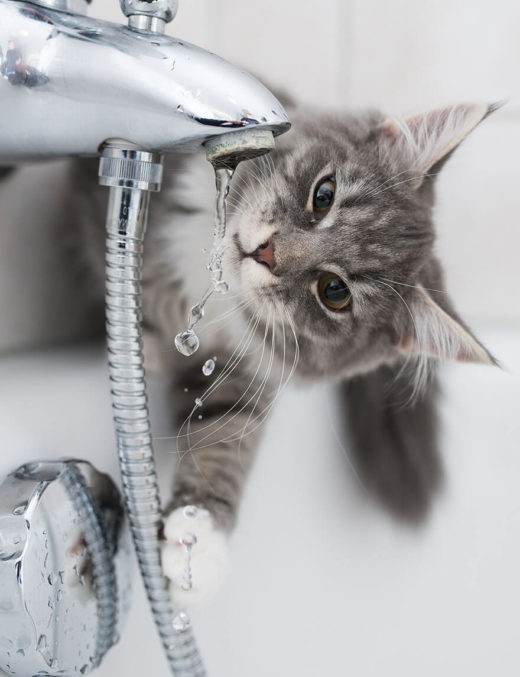
No matter what type of food your cat eats, it’s important to provide them with several sources of fresh drinking water. Unlike dogs, who may be comfortable eating and drinking in the same space, many cats have an aversion to their food and water dishes being close together. So, you want to provide at least a couple of water sources that aren’t located right next to the food dish.
It’s important to be willing to experiment with providing water for your cat. Cats are particular about their water sources. Some like running water, so a cat fountain can be a good idea. Other cats can be persuaded to drink water from a lit bowl. Many fountains combine lights and motion to intrigue cats.
Your cat may have feelings about their water bowl’s material. Ceramic or steel bowls are non-porous and easy to clean, so try those options before others. However, some cats prefer plastic or other options.
The shape of the bowl can also be a deterrent for some cats. Some may prefer a deep dish, while others may like a shallow one. Some cats also don’t want their whiskers to touch the sides of the dish, so a large or extra-wide bowl may help.
Cats may also be particular about the taste of their water. Some really prefer bottled water, while others actually like tap water. Cats are also likely to be able to taste additives in the water, such as dental supplements or electrolytes, so use these with caution and carefully evaluate your cat’s water intake.
Avoiding Urinary Tract Infections in Cats
A urinary tract infection is a common ailment that most cats will experience at least once in their lives. But if your cat is regularly going to the veterinarian for antibiotics to clear up their latest UTI or signs of inflammation found on their urinalysis, your cat may have a dietary problem.
Chronic dehydration increases the chance of your cat developing urinary tract problems. Without the optimal amount of water flowing through your cat’s urinary tract, bacteria have an opportunity to grow and multiply. Repeated or untreated urinary tract infections are linked to kidney failure later in your cat’s life. So, if urinary tract problems continue to rear their heads, it’s time to take a look at your cat’s overall hydration.
Feeding your cat a diet of frozen raw food or rehydrated freeze-dried food works as the best preventative for feline urinary tract diseases. Wet food, which is also packed with moisture, is something to try if your cat shuns raw food.
And if your cat absolutely refuses to eat anything that’s not kibble, looking for ways to make water more attractive is also something to try.
For cats already on a frozen raw or another moisture-rich diet, consider exploring other urinary tract disease triggers. Just like humans, some cats are prone to UTIs and urinary tract inflammation during times of stress. So if your cat is regularly hiding, vomiting or urinating in inappropriate places, they might need some stress relief.
try this: Preventing FLUTD from Reoccurring
Why Do Cats Often Develop Chronic Kidney Disease?
Low-level dehydration isn’t a problem for your cat if it occurs for a week. But without an optimal amount of water in their system, their internal organs must work a bit harder. Chronic dehydration is particularly difficult on the kidneys, which process urine. Overworking the kidneys can lead to a condition called chronic kidney disease (CKD).
One in five cats over the age of 15 will have CKD. It’s progressive, irreversible and terminal. And if your cat develops CKD, you may feel surprised by the diagnosis and how quickly it can progress. Veterinary testing only detects loss of kidney function when your cat has already lost 70 percent of kidney function or more. And sometimes CKD isn’t identified until your cat is seriously sick.
Cats with CKD need regular veterinary care to manage their condition, and you should consult with your cat’s veterinarian before making any dietary changes.
Prescription CKD cat food formulas may be required for your cat’s overall health. These formulas are very low in protein to reduce the strain on the kidneys.
When your cat has early stage CKD, you may want to discuss switching your cat to a raw diet with your veterinarian. Raw diets are high in protein, so conventional veterinary wisdom has suggested avoiding them if your cat has kidney problems. But a moisture-rich, high-quality protein diet, such as raw food or at least wet food, is also emerging as a valid option for cats with CKD. This type of diet works by alleviating the chronic dehydration that contributed to the initial problem. It also adds high-quality protein to your cat’s diet, so your cat’s kidneys don’t have to work as hard to process it.
Supplements to Improve Overall Feline Urinary Tract Health
Adding more water to your cat’s diet is the best way to improve their overall urinary tract health. But it’s not the only tool in your arsenal. Adding a supplement to your cat’s daily diet can support good urinary tract and kidney health.
Most urinary supplements work in one of three ways. Some work to make the urinary tract inhospitable to bacteria that cause infections. D-mannose protects the bladder wall from bacteria adhering to it. Cranberry extract contains proanthocyanidins that prevent E.coli—a bacteria that causes some UTIs—from sticking to the bladder walls as well as lowering the pH slightly (bacteria are very particular to the environment’s pH).
Other supplements work by decreasing overall inflammation of the urinary tract. Licorice, marshmallow root, glucosamine, saw palmetto, and gardenia are some ingredients that helps reduce inflammation. And others, such as dandelion, nettle, plantago seeds, couch grass, corn silk, and polygonum, work as a diuretic to flush the urinary tract system and dilute bacteria in the urine. Some other supplements that work by increasing urination are parsley and dandelion.
Kidney supplements work by increasing blood flow to the organ, which in turn boosts the overall filtration rate. Many kidney supplements have diuretic properties that help keep blood moving through the kidneys. Some supplements also contain herbs, such as corn silk, which help prevent the formation of kidney stones.
To battle stones and crystals in the urinary tract, supplements try to keep urine within a healthy pH range. Supplements that help address struvite crystals and stones elevate pH levels to make your cat’s urine more acidic. These supplements may contain ascorbic acid. But acidic urine is the cause of calcium oxalate crystals, so supplementation to make your cat’s urine more acidic could actually make the problem worse. That’s why we highly recommend discussing whatever supplementation you choose with your veterinarian, who can test any stones and develop a treatment plan based on the results.

When to Talk to Your Veterinarian About Problems Caused by Dehydration
Severe dehydration can be life-threatening, so it’s important to call your vet if you ever suspect your cat is severely dehydrated. Your veterinarian also should be the first person you call if you suspect your cat has urinary tract or kidney problems from dehydration. Changes in urination, increased thirst, vomiting, weight loss, uncontrolled urination, and lethargy are all signs of a possible kidney problem that needs attention immediately.
Urinary crystals or stones can cause blockages that create an emergency. Without the ability to expel urine, your cat can get very sick within a matter of hours. So if your cat is straining to pee, but can’t, make an emergency appointment with your veterinarian.
As you’ve probably guessed, you’ll need to take your cat to the veterinarian for help with any UTI or kidney problems once they have noticeable symptoms. But what about preventing these veterinarian visits in the future?
It’s worth discussing with your veterinarian what you can do to improve your cat’s overall urinary tract health. And if your cat already has diagnosed chronic kidney disease, any change in diet should be discussed with your veterinarian.